MU astronomers discover rare 'platypus galaxies' with mismatched parts
Please note this article originally appeared in Columbia Missourian on Feb 2, 2026. More information can also be found on NASA's website
A surprising new set of objects in space with mismatched parts has been discovered by University of Missouri astronomers, perhaps leading to a new understanding of the universe.
Thy look like stars but behave like galaxies, so the researchers named them “platypus galaxies” after the duck-billed, beaver-tailed mammal native to Australia. Much like their namesake, their properties don’t go together.
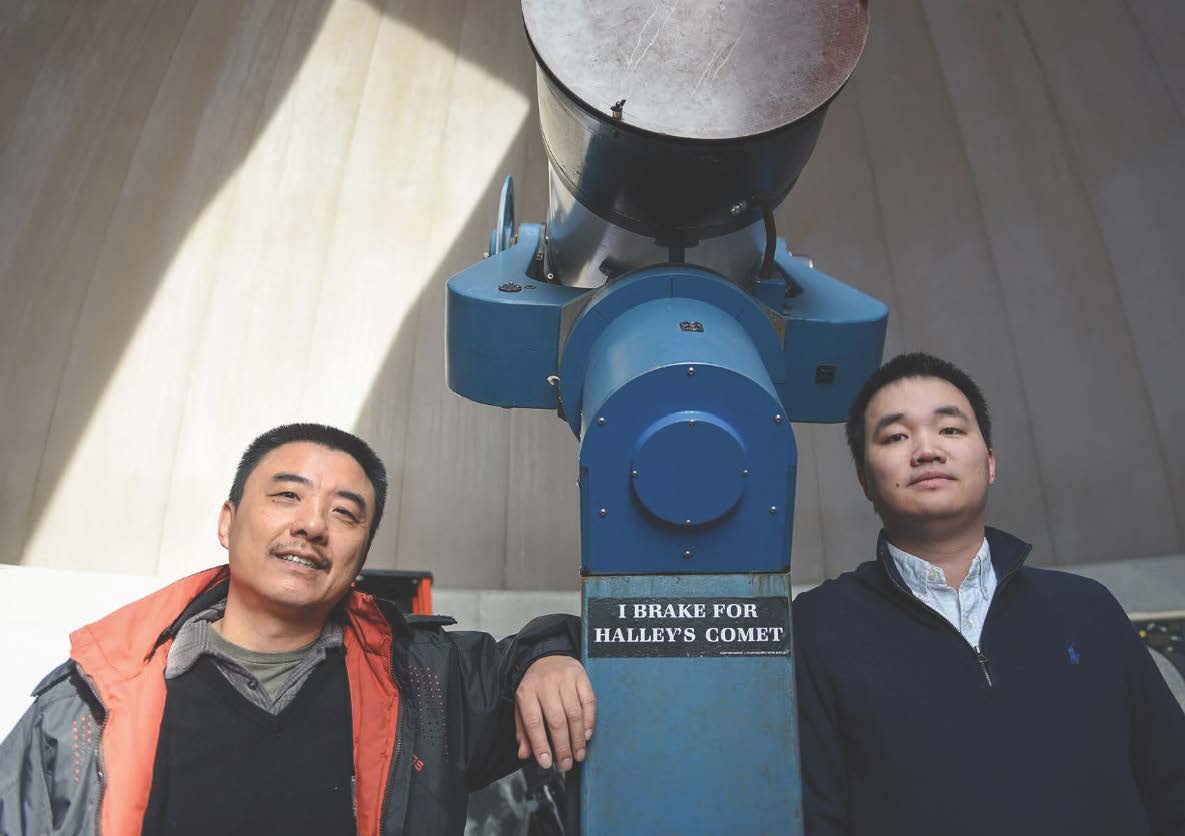
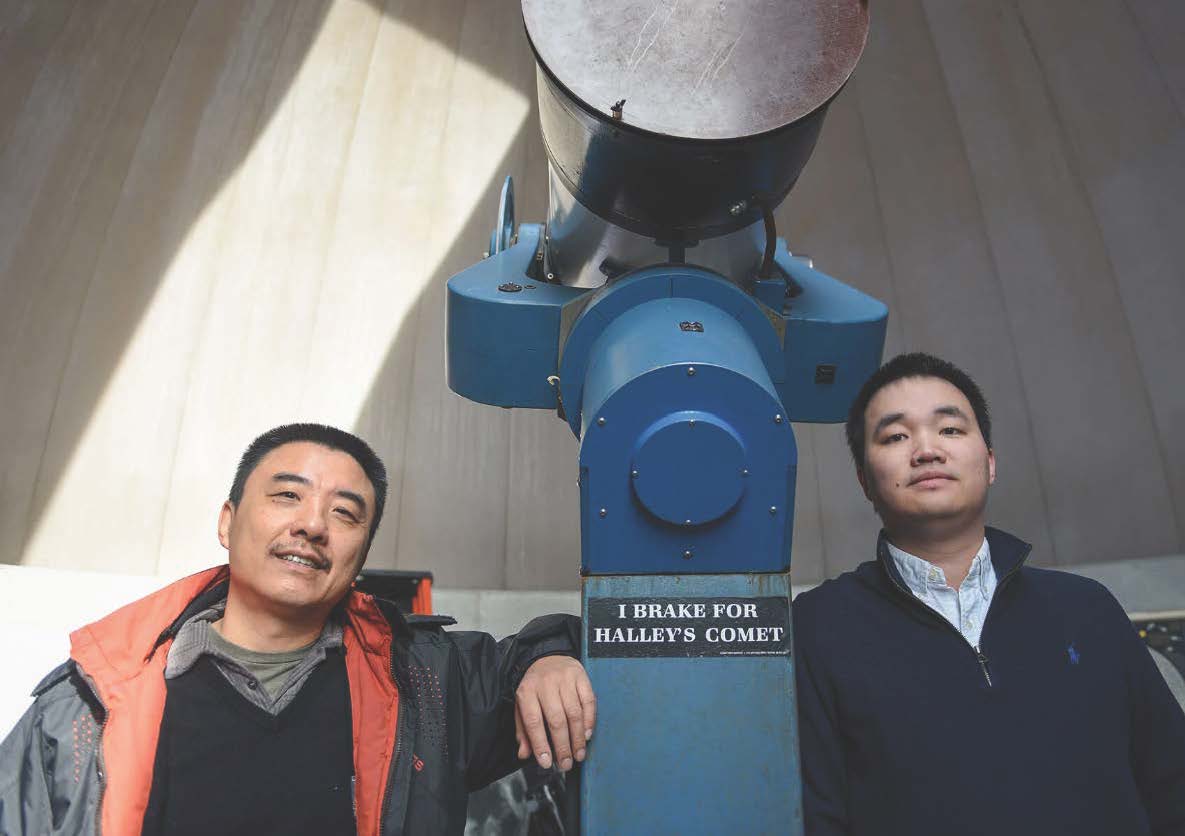
Lead researcher and Mizzou professor Haojing Yan identified the new class of celestial objects that look like stars but behave like full-fledged galaxies. Their parts are familiar, but together they create something strange.
“If you look at those features individually, they won’t be surprising,” he said. “It’s just that putting them together makes them look so odd.”
He and fellow co-author, graduate student Bangzheng Sun, presented their findings before the American Astronomical Society in Phoenix in early January.
What they found
Their research began in the spring of 2025 after a team of researchers in the Mizzou Department of Physics and Astronomy began noticing point-like objects in images from NASA’s James Webb Space Telescope.
The researchers observed that these new galaxies had properties unlike anything they had ever seen before. Based on the images alone, they determined that their point-like characteristics meant they could either be a star in the Milky Way or a quasar, a very bright beacon in the sky powered by black holes.
They decided that the image was too far away to be a star, and because its properties did not mimic a quasar, they dismissed that notion, as well.
With just nine objects found that shared similar properties out of a sample of 2,000 point-like sources, the discovery seemed like a rare and unusual occurrence that warranted investigation.
The team is now investigating whether the objects are actually a rare anomaly or a missing piece in our knowledge of the universe.
How they found them
Their study, “A New Population of Point-like, Narrow-line Objects Revealed by the James Webb Space Telescope,” sheds light on the findings.
Because the powerful telescope could allow the researchers to see the universe as it appeared billions of years ago, they were able to analyze what made the objects so puzzling.
According to the study, they used imaging to classify them as point-like sources and spectroscopy to reveal narrow emission lines or sharp spikes of light. Because these two qualities are abnormal when put together, the team decided “platypus” was an appropriate name.
“When we see something that we didn’t know previously, of course, we want to know that they really are,” Yan said. “The implications could be huge.”
The current accepted theory on how galaxies form is through usually violent collision.
“Our ongoing theory states that galaxies were formed by merging with other galaxies, often through violent collisions,” Yan said. “But these ‘platypus galaxies’ may have formed quietly, without such dramatic events. This suggests the early universe may have been more flexible and creative than we thought.”
If the objects were normal star-forming galaxies, the team should be seeing a high star formation rate because of how young the galaxy is, Sun said, but that is nowhere to be found.
“If (the objects) are normal star-forming galaxies, then their early star formation history is very unusual,” he said.
What’s next?
While more research is needed, the team plans to gather additional data on hundreds of other cosmic objects to see if they share these unusual traits.
The next step will be looking into a larger sample size and seeing if the objects form a substantial population, Sun said.
“We need to figure out what they are,” he said. “From there we can talk about the bigger implication.”
Yan added, “In any branch of science, it’s always those unexpected things that are most exciting.”